In late August 2025, Rexy Tseng invited me to his studio in Kreuzberg, Berlin. We had met a year before at a BPA// studio visit. It was then that we discovered our unexpected connection: we had both organized exhibitions in Armenia. In 2016, I curated the Dilijan Arts Observatory in a disused electronics factory, which required me to go back to Armenia over ten times. On his side, Tseng had accepted a call from the Armenian Center for Contemporary Experimental Art (NPAK) to engage in remote installations of his works. He visited Yerevan in 2023 and then again in 2025, when he had a solo show at this historical artist-run space. Our unlikely common ground orbited around the contingencies and adaptivity of a peripatetic practice. Art history is replete with models of intentional itinerancy, ranging from the nineteenth century flaneur to the roving painter and participant observer of twentieth century ethnography. In the early 1920s, Jugendstil artist Heinrich Vogeler abandoned his homestead in Germany and travelled to Moscow, recording on canvas what he witnessed on the way. Back in Berlin, he painted visual manifestos in an effort to convert the bourgeoisie to a communist way of life. Alf Bayrle (the father of artist Thomas Bayrle) accompanied German ethnographer Leo Frobenius to Ethiopia in the 1930s, drawing gravestones in situ before they were sacrilegiously removed and transported to Frankfurt. In both cases, the change of scene and the dialogues with the local intelligentsia encountered en route transformed the worldviews of these artists.
Tseng has been on the road since 2012, fearlessly displacing his practice into off-beat environments. His first shift of context was when he left Taipei for upstate New York at the age of thirteen. He recalls how dramatic it was for him. He continued drawing, as he had done since childhood, and later enrolled in studio art and new media at Carnegie Mellon University. There he acquired knowledge of both painting and kinetic art. After college, he worked as a software engineer, tasked to design publishing platforms for media companies. Tseng returned to art practice full-time in 2017, enrolling at the University of Oxford but leaving shortly afterwards, disillusioned by its parochialism. As a counterpoint to academia, he scheduled a cycle of residencies, aware that each station on the road would yield incomparable encounters. Beginning in Turin he travelled to Shanghai, Beijing, Tokyo, Paris, and St. Petersburg, finally returning to Taipei to live out the pandemic protected by his memory bank of impressions and friendships.
While of different generations, both of us recognize the danger of being fettered to a city or place and identified by a single ideational sphere that, like an orthodoxy of practice, can typecast an entire career. Tseng’s antidote to insularity is to forge alliances that transgress both locale and technology. In his work, the highspeed technicity of the engineer crashes against the slow empiricism of the nomadic painter, both equipped with a desire to retrieve what Michel de Certeau called an “erotics of knowledge"[1] and survive the unknown. Here an existential and intellectual engagement can be understood as a conspiracy to change that affects both life experience and models of practice.
In the BPA// exhibition at KW Institute for Contemporary Art in Berlin, Tseng parallels two scenarios of representation—painting and installation—through a common motif: the successive collision of people and things. In the painting, we witness a pile-up of human bodies merging into a civic mess in order to block the entrance into a parliamentary chamber. Tseng translocates a media image depicting the scene of a traditional brawl in Taiwanese politics. At least once a year, a confrontation breaks out between opposing parties. Members of parliament shove armchairs and tables into a doorway, barricading the entrance to literally prevent the opposing party from casting their vote. In this debating chamber of the absurd, Tseng paints pink flesh and upholstery so that they overlap, lose contour, and produce what he calls a “visceral mush”. The scene is set against the backdrop of a vertiginous wave set to hit the urban shore, potentially ramming all existence below it. Seditious behavior underscores a refusal to give over, be it to the tumultuous energy of a typhoon or the passing of new legislation. This farcical battle discloses the complexity surrounding China’s impounding relationship to Taiwan. Tseng renders this unforeseeable condition in sullied milky pigment producing an ethereal translucency that imbues the painting with affect and mystery. He elegantly slides questions of the political across different scales and discursive tropes, unlocking a feeling of the emergent, a present suspended in time and void of clear outcome. A gesture of surrender to foreign forces, be they state-driven or extra-terrestrial, characterizes the painting and the installation, lending both works a sense of foreboding anticipation.
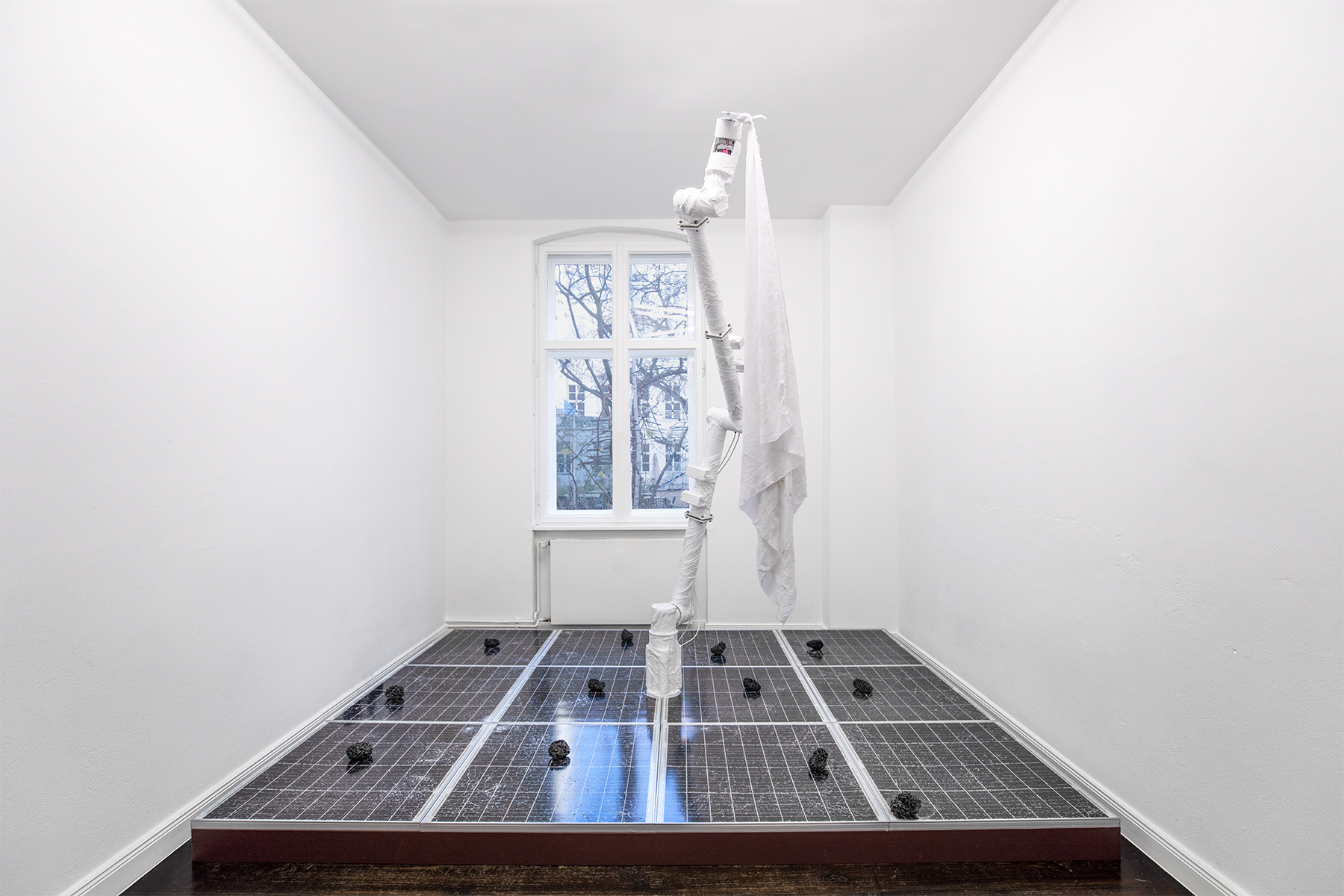
Placed in close proximity to the painting, and approximately the same dimensions, is a multilayered assemblage more than two by two meters in size. Defunct polycrystalline panels are placed on the floor as if it were a flat roof. At the center, protruding upward, like the branch of a tree or an extended fist, is a robotic arm brandishing a white flag. Surrounding this articulated flagpole is an accumulation of trash. In an art-historical flashback, the viewer may recall Théodore Géricault’s Raft of the Medusa (1818–1819), the painting that launched the artist’s career at the age of twenty-seven. It depicts the aftermath of a shipwreck, a subject that remains prescient and political two hundred years later. In his rendition of the motif, Tseng multiplies the connotations of uprootedness and ensuing vertigo by pitching the deathly pull of the ocean against the geo-magnetism of space. In both environments, detritus represents the fall-out of human agency, like a testimonial of social infrastructures that have failed, collapsed, and fragmented. Billion-dollar prototypes morph into unidentifiable rejects incessantly orbiting geopolitical space with earthly and spiritual refuse.
In his philosophical dialogue, Eupalinos or The Architect (1921), French writer Paul Valéry describes the seashore as “the frontier between Neptune and the Earth, which is always fought for by rival Gods.” He sees it as “the most macabre space of trade, the most unrelenting. It is there that we find that which has been rejected by the sea, that the earth knows not how to retain, the enigmatic debris, the hideous parts of shattered boats, as black as coal as if the saltwater had burned them, the spoiled carcasses polished by the waves, seaweed torn by storms from protean shores, deflated monsters in cold dying colours, all those things that are delivered to the fate of the waves, vile treasures of the sea…” [2] Walking along the seashore, his protagonist finds an amorphous white shape in the sand and asks whether this “ambiguous object” is a “work of life” or “a game of nature.” Has it been made “without self-awareness, worked out of its own substance, blindly forming organs and armatures, feeding and pulsating by itself, taking part in its own mysterious construction for time unknown?” Or could it be “the fruit of infinite time?” After scrutinizing it for a while, he throws it back into the sea, repelled by its “doubtful matter."[3]
Tseng piles up his similarly ambiguous detritus on solar panels, which act both as a street corner dumping ground and a parking lot for the floating debris of space capitalism. Scattered among this carambolage of cardboard, packaging, and plastic bags are meteorite sculptures formed from sponge dipped into concrete and charcoal and sprinkled with copper dust. The installation not only asks us to question the context-specificity of waste, but to look at the clues that trash can provide for a greater understanding of risk and impending failure. In the center of this scrapheap of ambition is the metallic arm, modelled on the articulated tool used to maintain the International Space Station. Like a human prosthetic, it waves the white flag of capitulation, anticipating the aftermath and its negotiation. With a touch of theatricality, the two components in the exhibition spar off each other, navigating the viewer back and forth between conjectural installation and conceptual painting.
Media collude and fracture in Tseng’s aesthetic world. Through his works, he calls into question familiar systems for organizing knowledge, be they about economy, society, or our interaction with the biosphere. He pitches pervasive images from virtual news media against the compelling effects of repeated electro-mechanical movement. Oil paintings of eviscerated news footage combine with kinetic installations constructed from animated multi-media components that appear to jump out of the picture plane. In this edgy symbiosis, he captures the elusive spirit of the moment and creates dialogical works that embody both hope and tragedy. The skill lies in making the different systems talk to one another, provoking a visceral response to what Tseng calls the “bruised optimism”[4] of our time.
- Clémentine Deliss
[1] Michel de Certeau, “The Expert and the Philosopher” in The Practice of Everyday Life, 1984, p. 37.
[2] Paul Valéry, Eupalinos or The Architect (Éditions de la Nouvelle Revue Francaise, 1921), 52–55, translation by the author.
[3] As above.
[4] Rexy Tseng, in conversation with the author, 21st August 2025, Berlin.
Dr. Clémentine Deliss works across the borders of contemporary art, curatorial practice, and publishing. She is Curator at Large at KANAL-Centre Pompidou in Brussels. She is also KANAL-Guest Professor at the Royal Academy of Fine Arts in Brussels, and Global Humanities Professor in History of Art at the University of Cambridge. Between 2020-2023, she was Associate Curator at KW Institute for Contemporary Art, Berlin. Her recent books include “The Metabolic Museum” (2020) and “Skin in the Game. Conversations on Risk and Contention” (2023) both published by Hatje Cantz/KW.