Repost from Contemporary Lynx
Sensitive Content quite literally refers to the warning overlay applied to algorithm-flagged posts on Instagram — for nudity, sexuality, violence, politics, or other contested material. At MAD Art Gallery in Poznań, Rexy Tseng, a Berlin-based Taiwanese artist working across painting and installation, confronts such “content” as a culture caught between censorship and exposure, that polices and consumes with equal appetite.
Social media’s algorithms and the culture of online approval have dulled creative risk and pushed toward more conservative expressions. Simultaneously, unlimited access to explicit content has emptied the idea of taboo; what was once forbidden is now endlessly available, stripped of mystery and charge. When everything can be shown, Tseng asks what still feels off-limits, and why do we keep returning to those edges?
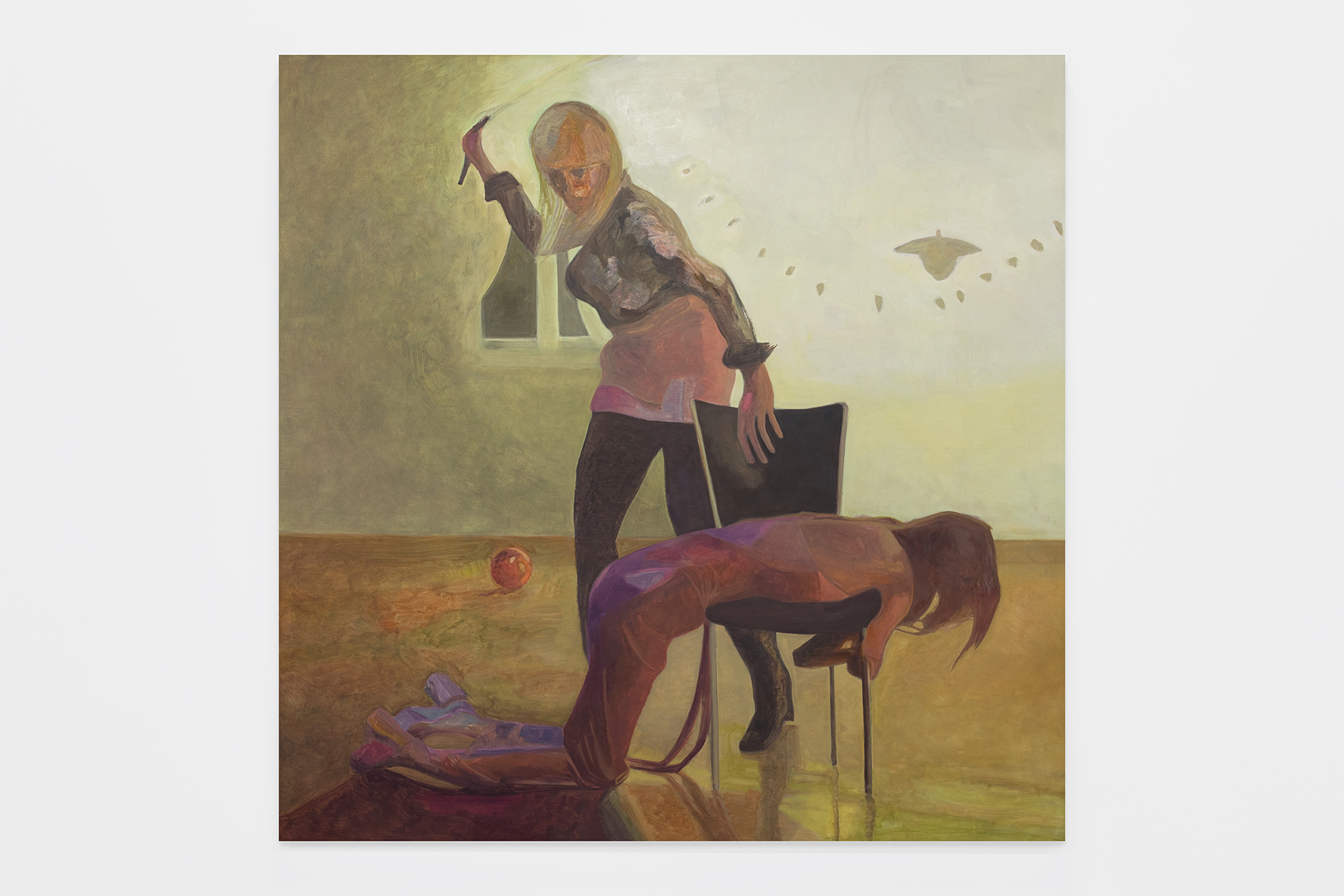
Klara Bender: As your exhibition opens here in Poland, I’d like to begin with your piece that references the Polish practice of pasowanie. What drew you to this particular image, and why did it feel important for the show?
Rexy Tseng: I came across it after messaging a Polish friend about local traditions. The algorithm then suggested a video of a young woman on her eighteenth birthday being lightly whipped by her family as a symbolic coming-of-age ritual. She wore a dress, and family members took turns gently whipping her, with no intent to harm. Since the exhibition is set in Poland, it references a local custom and carries a subtle kinky undertone. Poland is a deeply religious country, where Christianity shapes much of the collective subconscious. There’s this belief that the body must suffer to achieve spiritual elevation, and that, by default, we are all guilty. Within that framework, the act of whipping becomes symbolic: a means of control, to remind the young of guilt, to construct identity.
At the same time, there's the BDSM connotation, which is about deviating from societal boundaries and norms. If the norm is discipline, then the impulse is to escape it. What intrigued me about the tradition of pasowanie is how it combines these opposing forces. It reflects much about contemporary society and its relationship to the core idea of the show: our desires persist, even as we remain aware of the constraints that shape them.
We test the limits without ever completely breaking them. It's symbolic, almost mocking the idea of restraint. Today, people want to appear open-minded and progressive, but algorithms and social media constantly sanitise our world. We are pushed toward a polished, “Disney-like” reality. And yet we all know the internet’s dark side: the taboo spaces, the horrors, the open secrets. Nothing is truly forbidden anymore; everything is visible or can be generated. That accessibility blurs the divisions between desire, discipline, and control. That’s what I’m trying to question: where are the boundaries now?
KB: Your work connects together discipline, guilt, and play, and meaning seems to shift depending on who’s looking. Do you think cultural and moral frameworks shape how we read these tensions, between the erotic and the spiritual, the dominant and the submissive, in different ways?
RT: When someone understands its cultural context, the image gains a certain depth. But for someone outside that context, like me, this shifts entirely. What’s a rite of passage for one might appear purely erotic or even taboo to another. That’s the power of the image: it always carries two contexts — that of the artist and that of the viewer. They can align or conflict, but the dialogue is what gives visual art its meaning. My goal is for my paintings to live in that space of duality, where the work becomes conceptual rather than merely technical.
KB: When you create a piece like this, how do you imagine it being read in different cultural settings? And given that AI and digital manipulation can endlessly reproduce images and gestures, what happens when such imagery reappears in this new digital context?
RT: There’s something universal about whipping. As children, we instinctively understand punishment and discipline. Even biologically, we know where to strike, so it’s not truly harmful. As adults, we recognise another layer: the erotic power play between dominance and submission, how control can become intertwined with desire. Different audiences pick up on different aspects: Berliners might respond more directly to the kinkiness, while Polish viewers may see cultural ritual. My process begins intuitively. I find an image that draws me in, in this case, something strange yet distinctly Polish, and I start working without knowing why it speaks to me.
Through painting, I begin to understand its pull. The act of image-making becomes a way to deconstruct the image, to reinterpret it beyond its cultural background. Whether the image comes from AI or elsewhere doesn’t change much. What matters is the gesture and how we, as socially conditioned beings, respond to it. The image is just a vessel. And that is more potent than its formal composition or origin.
KB: So what do you think happens when that gesture becomes detached from the body, when AI or algorithms reproduce acts of pain or suffering?
RT: If we look into art history, the body has been a site of cultural, historical, and psychological suffering. In Western art, images of whipping or punishment appear frequently, especially in religious painting. The Church emphasised the body’s suffering as a path to salvation. What’s interesting about BDSM is how it reclaims boundaries and turns suffering into pleasure. Or rather, pleasure through suffering, where the desire to be punished allows the physical sensation itself to be enjoyed. That act of reversal is, to me, what good art does: it challenges what is proper.
Today, we see less of that. The art world is becoming more conservative, more hesitant to engage in subversive gestures. Take the image of whipping, for example — is it too much to show? It’s right on the borderline of political correctness. It’s not entirely there, but close. I believe potency exists in that grey zone, and we’re avoiding that conversation far too much in 2025.
KB: Do you think the art world has moved away from the taboo toward what feels politically safe or acceptable? Could this be a new kind of discipline, a form of self-censorship? How does that affect your own practice and the subjects you choose?
RT: A few months ago, I read an article noting a significant rise in floral paintings. It’s a safe and commercially viable choice. It’s not inherently bad, but it reflects a certain caution. I’ve noticed that trend myself: an abundance of floral imagery appearing again and again. There’s nothing wrong with flowers as a subject, but it often seems like a way to avoid risk. It’s safe, pleasant, and uncontroversial. I’ve painted flowers too, so I don’t dismiss it, but when it becomes a strategy to avoid difficult subjects, that’s when it feels empty.
Taboos still exist, though they’ve changed forms. Some topics are simply off-limits. But what concerns me is that this avoidance no longer defines boundaries or engages with discomfort; it just erases the conversation entirely. When artists only make safe work, they’re making a kind of blank statement and saying nothing at all. That’s more dangerous than confronting something uncomfortable.
KB: How has your own practice evolved since your student years, and how does it connect to the work you’re showing now in Sensitive Content?
RT: My practice has always consisted of two formats — painting and installation — both equally important. Over time, their relationship has evolved and become more cohesive. When I started, my installations were large conceptual statements while my paintings were more personal and expressive, almost existential. But there was a tension: the paintings lacked conceptual weight, and the installations lacked emotional resonance.
Over the years, I’ve been working to merge those qualities. Now, the paintings have developed a stronger conceptual foundation. The questions I keep returning to are: what does image-making mean to me today? And why am I painting in the 21st century?
KB: Did Sensitive Content help you answer those questions? What did this process reveal to you?
RT: Sensitive Content is directly tied to contemporary reality. The title itself is drawn from the language developed for the needs of social media, specifically the warnings we see before “inappropriate” material. This exhibition engages with technology and the ways we gather and share images: photographs taken on our phones, images suggested by search engines, content shared online. It deals with 21st-century subjects such as digital visibility, censorship, algorithms, and that brings my work up to the present moment. It has forced me to rethink older frameworks and make them relevant to the world we live in now.
KB: You’ve spoken about how this show brings you, as an artist, into a more current landscape. But there’s also the viewer, who is equally contemporary, shaped by short attention spans and constant digital stimulation. How do you think your work speaks to that? Does painting still operate within this surface-level culture of scrolling and instant judgment?
RT: That connects to the Andy Warhol quote I used for this exhibition about “the surface”. Warhol was a master of double-speak, appearing shallow while saying something truthful. Painting is about the surface. It is literally pigments and scratches on a surface. Our first interaction with a painting is always superficial; it is light reflecting off colours into our eyes. But beneath that lies something deeper: the capacity to move beyond the surface into introspection. Warhol said the only thing you can know about him is the surface, because we can never be in his head. Our entire experience of the other, of art, of the material world is mediated through surfaces. That’s not necessarily shallow; it’s just human.
There’s another quote by Oscar Wilde that says, “It is only shallow people who do not judge by appearances. The true mystery of the world is the visible, not the invisible”. It’s a tongue-in-cheek statement. It sounds like it’s glorifying shallowness, but if you think about it in the context of social media, it makes sense. That’s how we judge people now — in fragmented, limited ways. That’s how we engage with the external reality. I think the quote is ultimately about being honest with yourself as a viewer. And a painting is a physically shallow object. It’s all surface. Literally, my paintings are between two centimetres and five centimetres thick, and the painted surface is maybe two millimetres at most. Yet within that very limited physical space, we’re having a complex conversation.
I believe that’s part of why painting still exists, and why it continues to hold value, both conceptually and commercially. It is the staple of the art world, the thing that gets sold, collected, and passed on. So yes, there is a literal surface value to it. When I think of my audience, I am aware that contemporary art appeals to a small, focused group. Maybe twenty people attend your opening, and if five truly understand the work, that’s a success. I’ve accepted that. Creative work isn’t meant to be easy or immediately accessible. It’s meant to challenge.
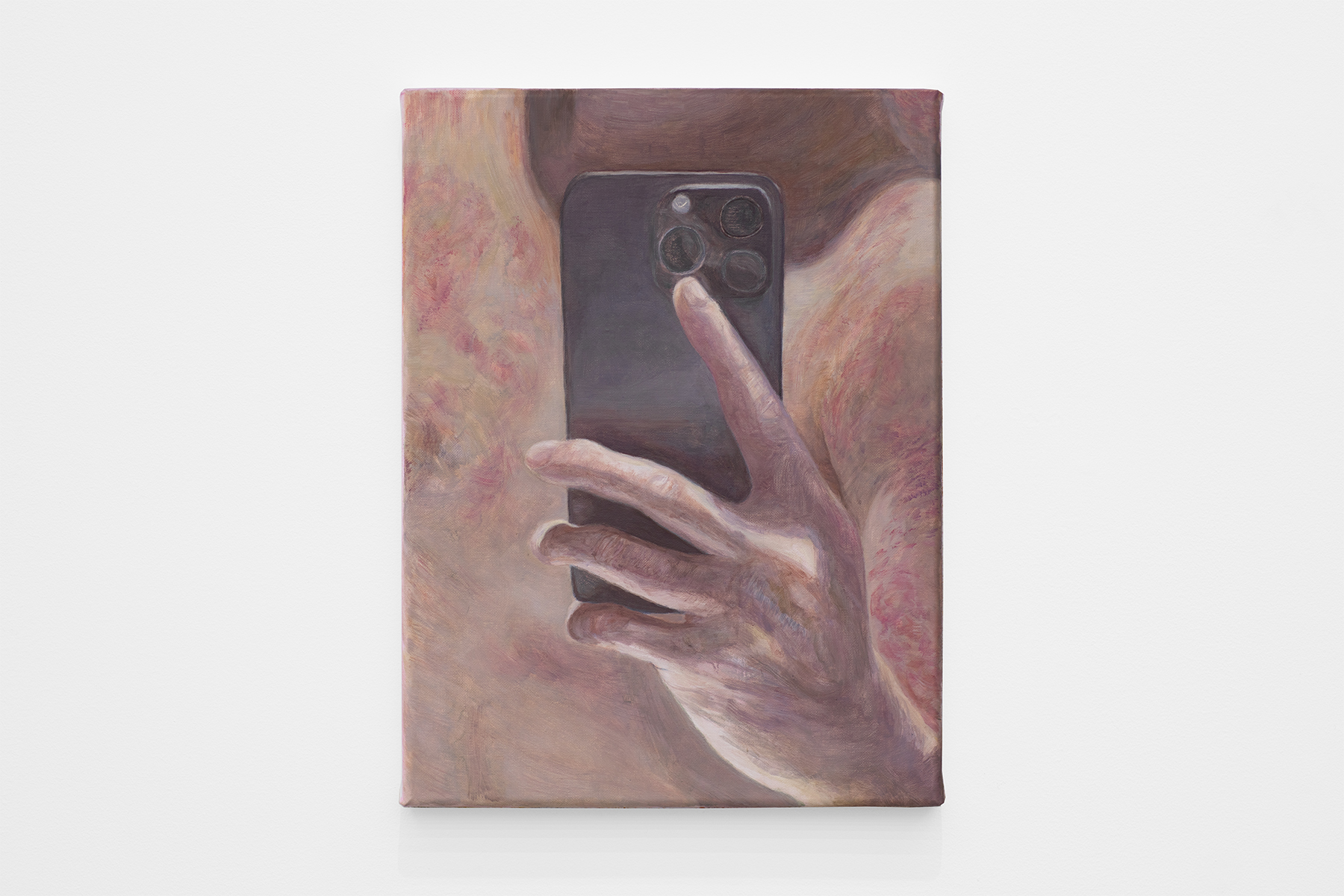
KB: Finally, could you tell me about the opening image of the show — the self-portrait with the camera? What made this image significant to include?
RT: It is the first self-portrait I’ve shown publicly. It felt like the right image to anchor the exhibition because it captures many of the core ideas. In the painting, I appear bruised, though it’s actually the result of an intense sports massage. It brings home everything in our conversation: the body as a site of suffering, and the dualism between the camera, which becomes our digital body in a way, and the physical body. There is a coexistence within the same image. The camera is both looking out and looking in. To me, this painting embodies the conceptual evolution I’ve been developing in my practice.
The image of the camera itself is central: the selfie as an ambiguous, slightly dangerous subject. The shiny phone and pristine digital world contrast with the bruised, textured skin in the painting. These tensions — surface and texture, digital versus physical, discipline and censorship — all come together. It even touches on social media’s logic: posting this image could potentially trigger a “sensitive content” warning, but it’s just me after a massage, nothing extreme. This image solidified the concept of the exhibition.
- Klara Bender